
Governance, Risk, Compliance and Resilience. Connected by Design.
iShield GRC connects enterprise risk, compliance, controls, assurance and specialized governance Areas through one integrated operating model—enabling informed decisions, coordinated accountability and continuous improvement.
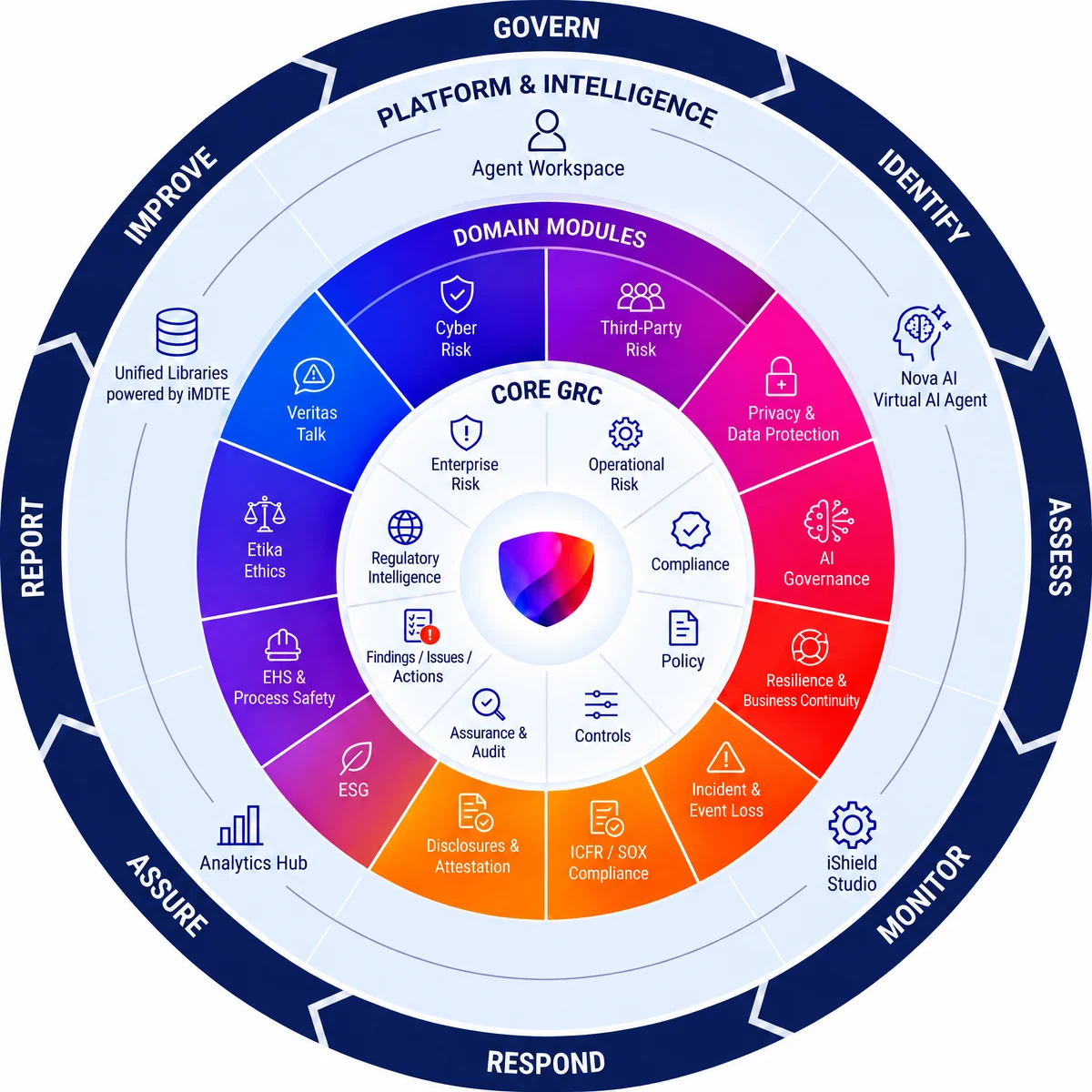
25 capabilities · four Areas · one eight-stage lifecycle · one governance information foundation.
Governance intelligence for the whole enterprise
Boards and executives need more than compliance status. They need to understand how risks, obligations, controls and disruptions relate to each other — and who is accountable for acting on them. iShield GRC organises governance around that question.
Enterprise-wide governance intelligence
Risk, compliance, control, incident and assurance information is drawn from a common governance foundation and presented through Analytics Hub, giving leadership one reference point across disciplines.
Connected accountability
Owners, reviewers, risk functions and internal audit work within a shared workspace, with responsibilities traceable from the first line to independent assurance.
Risk-informed decisions
Risks are assessed against the controls, obligations and events that affect them, so priorities reflect actual exposure rather than isolated registers.
Assurance you can rely on
Controls are defined once in the governed library and mapped to the obligations they support, so testing, evidence and findings build a consistent assurance record.
Organisational resilience
Continuity, incident, safety and third-party disciplines sit beside enterprise risk, so disruption is planned for, rehearsed and learned from within the same governance model.
From parallel programmes to one governance system
Mature organisations often run risk, compliance, audit, resilience, privacy and ethics as parallel programmes. Each may be well run. Together they leave gaps between owners, taxonomies and evidence.
Parallel programmes
- Different taxonomies for the same risks, controls and obligations
- Evidence requested repeatedly by different functions
- Findings tracked apart from the risks and controls they concern
- Regulatory change handled informally, with unclear ownership
- Leadership reporting reconciled by hand
One governance system with iShield GRC
- Common definitions and taxonomies maintained in Unified Libraries / iMDTE
- Controls mapped to the obligations and risks they address
- Findings, issues and actions linked to their source assessments, audits and incidents
- Regulatory change triaged and assigned as owned work in Regulatory Intelligence
- Leadership reporting built from governed platform information in Analytics Hub
The difference is one integrated governance operating model — connecting enterprise risk, compliance, assurance, resilience, ethics and speak-up through a common governance information foundation.
One lifecycle. Every discipline.
Each capability contributes to the same eight-stage cycle, so governance work progresses through defined stages rather than being handed between disconnected systems.
Stage 1 of 8
Govern
Set direction, policies, ethics and the obligations the organisation commits to.
- Policy Management
- Etika
- AI Governance
- Regulatory Intelligence
- Unified Libraries / iMDTE
Stages describe how capabilities relate; each organisation configures the cycle to its own governance model.
An integrated architecture, not a collection of modules
At the centre is Unified Libraries / iMDTE — the common governance information foundation supporting shared definitions, taxonomies and governed relationships across applicable capabilities. Agent Workspace provides a shared place to work and Analytics Hub a shared view across disciplines. Area capabilities for risk, compliance and specialised governance build on this foundation where applicable, helping keep core definitions consistent.
Governance information foundation
Unified Libraries / iMDTE
Shared platform
Agent Workspace, iShield Studio, Analytics Hub, Nova AI
Area capabilities
20 capabilities across three governance Areas
Core governance and risk
Two Areas form the backbone of most enterprise programmes.
Risk, Resilience & Incidents (6)
From enterprise and cyber risk to safety, continuity and loss events — one governed risk lifecycle.
Enterprise Risk Management (ERM)
Identify, assess, treat and monitor enterprise risks with intelligence and precision
Explore on ishieldgrc.com — Enterprise Risk Management (ERM) (opens ishieldgrc.com in a new tab)Operational Risk Management
Control operational uncertainty — connect risk to everyday decisions
Explore on ishieldgrc.com — Operational Risk Management (opens ishieldgrc.com in a new tab)Cyber Risk Management
Govern cyber risk end-to-end — from the SOC to the board
Explore on ishieldgrc.com — Cyber Risk Management (opens ishieldgrc.com in a new tab)EHS & Process Safety Risk Management
Environment, health, safety and process safety on a single operational cockpit
Explore on ishieldgrc.com — EHS & Process Safety Risk Management (opens ishieldgrc.com in a new tab)Resilience & Business Continuity
Ensure continuity, maintain confidence and protect critical operations
Explore on ishieldgrc.com — Resilience & Business Continuity (opens ishieldgrc.com in a new tab)Incident & Event Loss Management
Respond faster, understand impact better and prevent recurrence
Explore on ishieldgrc.com — Incident & Event Loss Management (opens ishieldgrc.com in a new tab)
Compliance, Controls & Assurance (8)
Obligations, policies, controls, audits and financial-reporting assurance — connected end to end.
Compliance Management
Transform compliance into a strategic advantage — automated and always up to date
Explore on ishieldgrc.com — Compliance Management (opens ishieldgrc.com in a new tab)Regulatory Intelligence
See regulatory change coming — and turn it into action inside the platform
Explore on ishieldgrc.com — Regulatory Intelligence (opens ishieldgrc.com in a new tab)Policy Management
Create, govern and enforce policies across your entire organization
Explore on ishieldgrc.com — Policy Management (opens ishieldgrc.com in a new tab)Controls Management
Establish, govern and optimize your control environment with precision
Explore on ishieldgrc.com — Controls Management (opens ishieldgrc.com in a new tab)Assurance & Audit Management
Connect audit controls, evidence and findings across your audit lifecycle
Explore on ishieldgrc.com — Assurance & Audit Management (opens ishieldgrc.com in a new tab)ICFR / SOX Compliance Management
Run a defensible SOX 302 and 404 programme on a single, audit-ready platform
Explore on ishieldgrc.com — ICFR / SOX Compliance Management (opens ishieldgrc.com in a new tab)Disclosures & Attestation Management
Certifications, sub-certifications and disclosure workflows across the enterprise
Explore on ishieldgrc.com — Disclosures & Attestation Management (opens ishieldgrc.com in a new tab)Findings, Issues & Actions Management
One register for every finding, issue, remediation action and closure evidence
Explore on ishieldgrc.com — Findings, Issues & Actions Management (opens ishieldgrc.com in a new tab)
Specialised and emerging governance
Expectations around sustainability, suppliers, personal data, AI and conduct continue to grow. iShield GRC brings these disciplines into the same lifecycle and information foundation instead of creating new silos.
ESG Management
Drive sustainable performance with intelligent ESG oversight
Explore on ishieldgrc.com — ESG Management (opens ishieldgrc.com in a new tab)Third-Party Risk Management (TPRM)
Centralized visibility and control over your vendor, supplier and partner ecosystem
Explore on ishieldgrc.com — Third-Party Risk Management (TPRM) (opens ishieldgrc.com in a new tab)Privacy & Data Protection
Operationalize GDPR, CCPA and global privacy law on one governed platform
Explore on ishieldgrc.com — Privacy & Data Protection (opens ishieldgrc.com in a new tab)AI Governance
Govern the AI your organization builds, buys and embeds
Explore on ishieldgrc.com — AI Governance (opens ishieldgrc.com in a new tab)Etika: Code of Ethics System
Build a culture of integrity, transparency and responsible behavior
Explore on ishieldgrc.com — Etika: Code of Ethics System (opens ishieldgrc.com in a new tab)Veritas Talk: Whistleblower System
Empower your workforce to speak up safely, confidently and anonymously
Explore on ishieldgrc.com — Veritas Talk: Whistleblower System (opens ishieldgrc.com in a new tab)
Ethics and speak-up are part of the core portfolio — Etika for codes of conduct and Veritas Talk for confidential reporting.
Shared platform and governed AI
Five shared capabilities support every Area. They are the foundation the Area capabilities run on, not separate business modules.
Agent Workspace
A unified, role-aware workspace where every GRC practitioner and Nova AI collaborate on tasks, assessments, reviews and approvals — with full context, evidence and audit trail.
Explore on ishieldgrc.com — Agent Workspace (opens ishieldgrc.com in a new tab)Unified Libraries / iMDTE
A single, governed library of entities, taxonomies, controls, risks, obligations and enumerations that every iShield module — and every AI agent — consumes as the source of truth. One definition, one owner, one lifecycle: used everywhere.
Explore on ishieldgrc.com — Unified Libraries / iMDTE (opens ishieldgrc.com in a new tab)iShield Studio
A governed low-code environment where business teams design forms, automate workflows, compose dashboards and publish content — while inheriting the platform's security, taxonomy and audit trail by default.
Explore on ishieldgrc.com — iShield Studio (opens ishieldgrc.com in a new tab)Analytics Hub
One analytics fabric that unifies signals from every GRC discipline — risk, compliance, controls, audit, ICFR, ESG, privacy, EHS, third-party, cyber, incidents and disclosures — powered by the iMDTE backbone.
Explore on ishieldgrc.com — Analytics Hub (opens ishieldgrc.com in a new tab)Nova AI / Virtual AI Agent
A governed, explainable, enterprise-grade AI assistant embedded across the platform. Nova AI answers GRC questions from your governed data, drafts assessments and disclosures, and executes tasks — with human-in-the-loop control and AI Governance oversight.
Explore on ishieldgrc.com — Nova AI / Virtual AI Agent (opens ishieldgrc.com in a new tab)
AI that assists, recommends and acts — under governance
- Assistance
- Nova AI / Virtual AI Agent answers GRC questions from governed data and summarises risks, controls, incidents and findings.
- Recommendations and drafting
- It drafts assessments and disclosures and proposes next steps for practitioners to review.
- Permission-scoped task execution
- It can carry out tasks on behalf of users within their permissions and approved governance controls, with each action traceable. It does not act without restriction.
- Configurable human oversight and governance
- Human-in-the-loop controls and AI Governance oversight apply, configured to the organisation's policies.
Nova AI is the assistant inside the platform. AI Governance is a separate capability for governing the organisation's own AI systems, models, use cases and related obligations.
Responsible AI & Data UseGovernance journeys across capabilities
The following are representative examples of how governance work can move across capabilities within one lifecycle. Each organisation configures its own workflows.
Regulatory change to assured control
A new obligation is captured and assessed in Regulatory Intelligence and assigned an owner. The affected policy is reviewed in Policy Management, related controls are updated in Controls Management, testing and evidence are managed in Assurance & Audit, and gaps are tracked to remediation in Findings, Issues & Actions.
Lifecycle stages: Govern (show stage in lifecycle)Identify (show stage in lifecycle)Monitor (show stage in lifecycle)Assure (show stage in lifecycle)Improve (show stage in lifecycle)
Incident to stronger resilience
An event is recorded and investigated in Incident & Event Loss Management. Its impact informs the related risk assessment in ERM or Operational Risk, affected continuity plans are reviewed in Resilience & Business Continuity, and corrective actions are tracked to closure.
Lifecycle stages: Respond (show stage in lifecycle)Assess (show stage in lifecycle)Improve (show stage in lifecycle)
Supplier onboarding to ongoing oversight
A third party is assessed in TPRM, personal-data considerations are reviewed in Privacy & Data Protection, relevant controls and evidence are linked in Controls Management, and issues are assigned owners and monitored.
Lifecycle stages: Identify (show stage in lifecycle)Assess (show stage in lifecycle)Monitor (show stage in lifecycle)Respond (show stage in lifecycle)
Control testing to attestation
Financial-reporting controls are tested in ICFR / SOX, deficiencies are remediated, results support sign-off in Disclosures & Attestation, and Analytics Hub provides a consolidated view for leadership.
Lifecycle stages: Assure (show stage in lifecycle)Report (show stage in lifecycle)
AI use case to governed operation
A proposed AI use case is registered, classified and assessed in AI Governance, related risks are recorded in ERM, controls are applied and evidenced, and the use case is monitored over time.
Lifecycle stages: Govern (show stage in lifecycle)Assess (show stage in lifecycle)Monitor (show stage in lifecycle)
Governance shaped by your sector
Each industry faces its own regulators, risks and stakeholders. iShield GRC applies the same lifecycle to the obligations that matter in your sector.
Financial Services
Evidence for DORA, Basel III and PCI DSS obligations, gathered as work happens.
Healthcare
Patient-data obligations under HIPAA and local health laws, tracked with evidence.
Technology & SaaS
SOC 2 and ISO 27001 control evidence for fast-scaling software teams.
Energy & Utilities
NERC CIP and OT/ICS risk, controlled and evidenced across critical operations.
Manufacturing
Supply-chain risk and ISO 27001 controls, evidenced across every site.
Retail & E-commerce
PCI DSS and third-party risk evidence across every sales channel.
Government
FedRAMP, NIST and data-sovereignty obligations, tracked and evidenced.
Education
FERPA and student-data obligations, governed and ready to show.
Telecommunications
Network-resilience and cross-border rules, evidenced in one place.
Regulations are shown for context and do not imply certification.
Part of a connected enterprise estate
iShield GRC is one of five iShield platforms — iShield Nexus for business and IT service management, iShield Connect for customer and partner relationships, iShield One for enterprise resource planning, iShield Link for integration and iShield GRC for governance, risk and compliance. Integration scope is defined for each environment.

Enterprise ITSM
Explore iShield Nexus
Enterprise CRM
Explore iShield Connect
Enterprise ERP
Explore iShield One
Enterprise Integration
Explore iShield Link
Our security and privacy commitments are set out in the Trust Center, and our approach to AI in Responsible AI & Data Use.
Used in these business solutions
iShieldGRC modules are composed into these outcome-led iShield solutions — each one combines capabilities across Nexus, Connect, One, Link and GRC.
Explore all 25 capabilities
Filter by Area to find the capabilities that fit your programme. Each opens its detailed page on ishieldgrc.com.
Platform, Workspace & Intelligence
The shared foundation every GRC discipline runs on — one workspace, one data backbone, one analytics fabric and one AI agent.
- Shared platform capability
Agent Workspace
One operational workspace for GRC agents, analysts, reviewers and Nova AI
- Shared platform capability
Unified Libraries / iMDTE
The master data, taxonomies and enumerations backbone of every iShield module
- Shared platform capability
iShield Studio
Low-code studio to configure forms, workflows, dashboards and content
- Shared platform capability
Analytics Hub
Executive dashboards, KRIs, KPIs and drill-down analytics across every discipline
- Shared platform capability
Nova AI / Virtual AI Agent
Conversational AI that guides users, answers GRC questions and executes tasks
Questions enterprise buyers ask
- They share a common governance information foundation, Unified Libraries / iMDTE, which maintains the taxonomies, risks, controls and obligations each capability uses, along with a shared workspace and analytics. Work is organised around one eight-stage governance lifecycle, so related activity in different capabilities can be connected and reported consistently.
- No. Organisations can begin with capabilities aligned to their immediate priorities — such as Enterprise Risk Management, Compliance Management or ICFR / SOX — and expand their scope over time. We can help you define a starting scope during a demonstration.
- Implementation is planned with your team around your governance model, frameworks, existing data and priorities. Scope, sequencing and responsibilities are agreed during discovery rather than fixed in advance.
- Nova AI provides assistance, drafting, recommendations and task execution within user permissions, with human-in-the-loop controls and AI Governance oversight. Separately, the AI Governance capability helps organisations govern their own AI systems and related obligations. Our Responsible AI & Data Use page describes our commitments.
- iShield GRC is designed to operate alongside the iShieldSoft platforms, and connections to other enterprise systems can be assessed through iShield Link. Integration requirements are reviewed for each environment.
- Deployment options are discussed for each organisation's requirements during the evaluation process.
- Request a demonstration and tell us which capabilities and governance challenges matter most. We will tailor the session to your priorities.
See connected governance in action
Tell us about your governance priorities and we will show how iShield GRC connects risk, compliance, assurance and resilience on one governance foundation.